
Does Your Water Source Matter?
Introduction: Why Your Water Source Deserves a Closer Look
Most people think all water is basically the same—clear, refreshing, and safe to drink. But the truth is that the source of your water directly influences what’s in it, the contaminants in the water, how it tastes, how it performs in your home, and what steps you may want to take before drinking it. Whether your tap comes from a municipal treatment plant, a private well, a bottled water brand, or a home purification system, each source carries its own potential contaminants.
Understanding where your water comes from helps you make informed choices about purity, taste, and consistency. This guide breaks down the most common water sources and explains why water quality can vary so widely.
1. Municipal Tap Water
Most households in the United States receive water from a municipal or city water supply. This water typically comes from lakes, rivers, reservoirs, or groundwater and is processed through treatment plants before reaching your tap.
What to Know About Municipal Water
- It is disinfected with chlorine or chloramine to help reduce microbial contaminants.
- It may contain dissolved minerals, metals, and naturally occurring substances from the original water source.
- Aging infrastructure, distribution lines, and local water conditions can influence water quality by the time it reaches your home.
- Municipalities follow federal regulations set by the U.S. Environmental Protection Agency (EPA), but treatment levels and contaminant profiles vary from city to city.
Why People Still Purify Municipal Water
Although it meets legal standards, municipal tap water can vary in both quality and taste. It has been known to contain levels of substances such as disinfectant byproducts, sediment, and metals. Many households choose to purify their water for greater consistency and peace of mind.
2. Private Well Water: Natural, Untreated, and Highly Variable
About 42 million U.S. homes rely on private wells. Unlike municipal systems, wells are not regulated by the EPA, which means homeowners are responsible for testing and managing their own water quality.
What to Know About Well Water
- Its composition depends on local geology and environmental conditions.
- It can contain minerals such as iron, manganese, and hardness-causing calcium and magnesium.
- Wells may also be exposed to agricultural runoff, septic issues, or naturally occurring contaminants such as arsenic or nitrates.
- Taste, odor, and clarity can vary seasonally or after heavy rainfall.
Why Many Well Owners Choose Purification
Because well water is untreated and may shift over time, homeowners often use purification systems—such as distillation—to achieve consistent quality for drinking and cooking.
3. Bottled Water: Convenience with a Wide Range of Standards
Bottled water is often marketed as “fresh,” “spring,” or “purified,” but the actual composition depends on how the water was sourced and processed.
Types of Bottled Water
- Spring Water: comes from underground sources but may still contain minerals or environmental contaminants.
- Purified Water: has undergone processing, though not all purified bottled waters follow the same standards.
- Mineral Water: contains naturally occurring minerals, which vary by source.
Considerations with Bottled Water
- Taste varies across brands due to mineral content and source water.
- Storage conditions and packaging materials can affect water quality.
- Costs add up quickly over time compared to producing purified water at home.
Many consumers choose home distillation because it provides purity without the recurring expense.
4. Reverse Osmosis Systems: Popular but Not Identical to Distillation
Reverse osmosis (RO) is a common home treatment method. It pushes water through a semipermeable membrane that helps reduce many contaminants.
Things to Know About RO
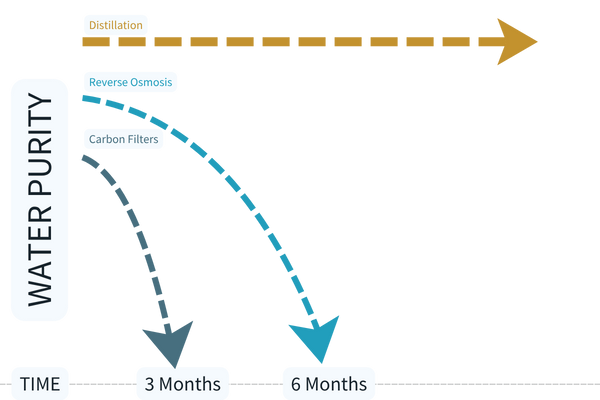
- RO systems typically include multiple filters that need regular maintenance.
- They can reduce a broad range of dissolved solids but are not designed to remove all types of contaminants.
- RO does have some wastewater attributed.
- Water quality can vary depending on membrane age and local water conditions.
People who switch from RO to distillation often do so for consistency and lower long-term maintenance.
5. Distilled Water: Replicating the Hydrologic Cycle at Home
Distillation is the most consistent and comprehensive purification methods available for household use. It mirrors nature’s hydrologic cycle of evaporation, condensation, and precipitation, to produce water that has been separated from minerals, chemicals, and other impurities.
How Distillation Works
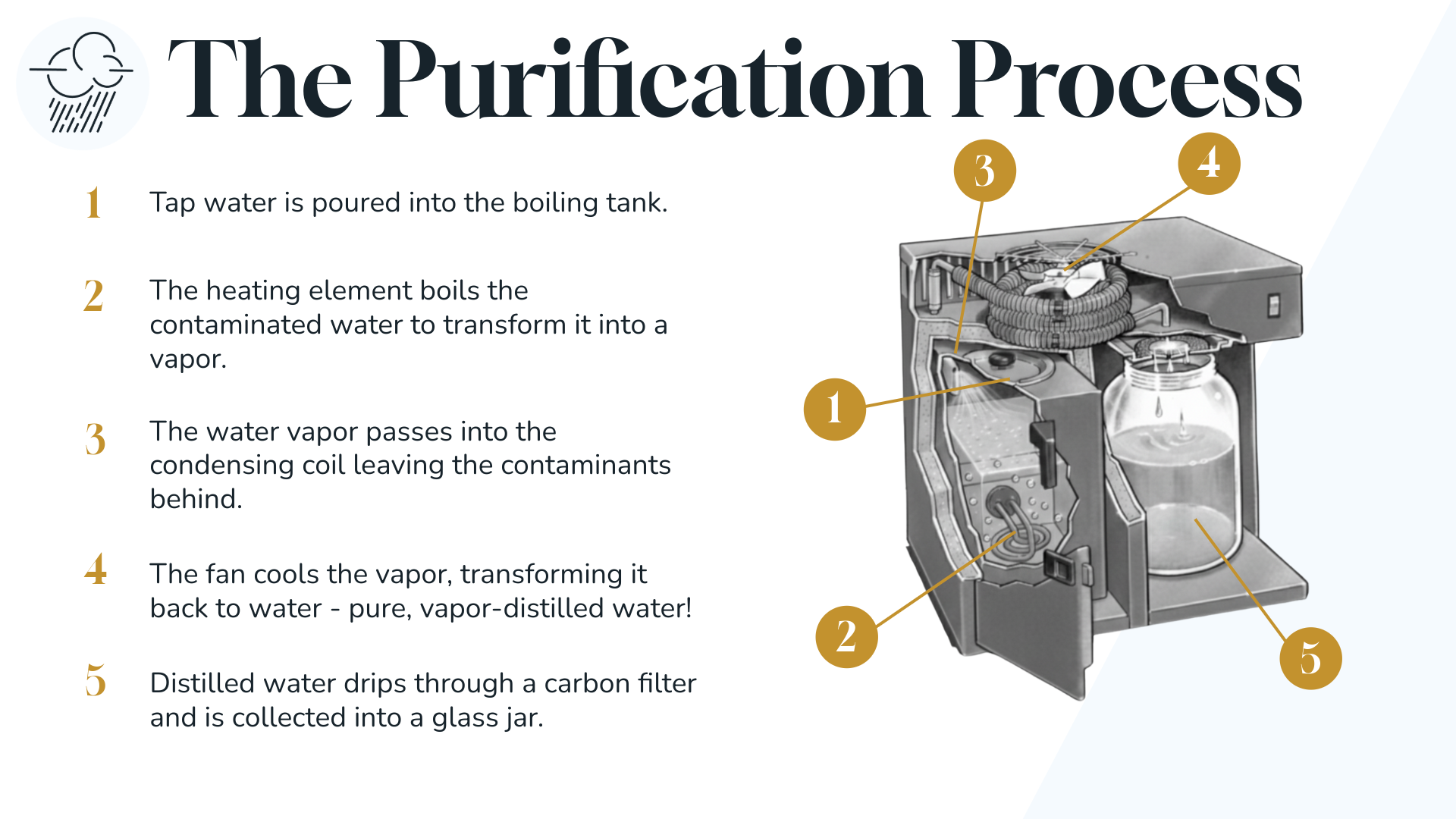
- Water is heated until it becomes steam.
- Contaminants with higher boiling points remain in the boiling chamber.
- The steam is condensed back into water inside a clean, separate container.
- A final activated carbon filter may be used to target volatile gases.
Why Many Households Prefer Distillation
- It provides consistent, predictable purity regardless of the incoming water source.
- It removes both dissolved and particulate contaminants.
- It’s effective on well water, municipal water, and bottled water.
- It eliminates concerns about degradation.
For households that want the same quality every day, no matter what the tap water is doing, distillation offers an added level of confidence and convenience.
6. Why Your Water Source Ultimately Matters
Your water source affects:
- What’s in your water (minerals, sediments, contaminants)
- How it tastes
- How it interacts with home appliances
- How consistent it is throughout the year
Two households in the same city can have very different water experiences based on pipe materials, distance from treatment plants, and local conditions. This is why so many families choose to take control of their water quality rather than rely solely on the source.
Purifying water at home, especially through distillation, gives you the same composition every time, regardless of changing environmental, seasonal, or infrastructure factors.
What to do Next
Where your water comes from ultimately determines what is dissolved in it, how it tastes, and its consistency over time. Many households are choosing methods to increase the purity level of their drinking water. While many purification methods can affect the purity of your water, only one method comes out on top.
Distillation offers something unique: it separates your water from impurities through a controlled physical process. By heating water until it becomes steam and condensing it, distillation helps reduce a wide range of substances, including dissolved solids, metals, and particles, without relying on filters that degrade over time. Because you are physically transforming the water, the finished water’s composition remains consistent from batch to batch.
This consistency is one of the key reasons households choose distillation. Whether your input source is highly mineralized well water, chlorinated municipal water, or a variety of bottled water brands, the output is predictably purified. The process functions like a miniature version of the hydrologic cycle: evaporation, condensation, and precipitation. Pairing distillation with a post-treatment carbon filter further enhances taste and final-polishes the water.
In the end, your water source does matter, but what matters most is having a solution that gives you clarity, consistency, and confidence regardless of where that source begins. Distillation allows you to take control of what goes into your glass, helping ensure that the water you use every day is as purified and uniform as possible.
Distillation offers a simple, reliable way to produce high-purity water at home, no matter where your water begins.



Leave a Reply