When people think about drinking water quality, they often focus on things they can see, smell, or taste. But some of the most important factors affecting water quality are completely invisible, and arsenic is one of them.
Arsenic is a naturally occurring element found in soil, rock, and groundwater. While it has no color, taste, or odor in water, its presence is closely monitored by many homeowners and communities. Understanding where arsenic comes from, how it enters drinking water, and what it means for long-term water quality can help you make more informed decisions about your water.
What Is Arsenic?
Arsenic is a naturally occurring element found throughout the Earth’s crust. It exists in both organic and inorganic forms, with inorganic arsenic being the most common form found in groundwater.
Because arsenic is part of natural geology, it can dissolve into groundwater over time. This means that even in areas without industrial pollution, arsenic may still be present in well water or municipal sources.
How Does Arsenic Get Into Drinking Water?
There are two primary ways arsenic can enter drinking water:
1. Natural Sources
In many regions, arsenic leaches into groundwater from surrounding rock and soil. This is the most common source, especially for private wells.
2. Human Activity
Although less common than natural sources, certain human activities can contribute to arsenic levels, including:
Historical use of arsenic-based pesticides
Industrial processes and waste
Mining operations
Improper disposal of arsenic-containing materials
Because arsenic can come from both natural and human-related sources, it can be found in both private wells and public water systems.
Why Arsenic in Water Matters
One of the biggest challenges with arsenic is that it is undetectable without testing. Unlike chlorine or sulfur, arsenic does not create a noticeable smell or taste in water.
This means that water can appear completely clear and fresh while still containing measurable levels of arsenic.
For this reason, water testing is the only reliable way to determine whether arsenic is present.
Understanding Regulatory Standards
In the United States, the U.S. Environmental Protection Agency (EPA) has established a Maximum Contaminant Level (MCL) for arsenic in public drinking water systems:
10 parts per billion (ppb)
This standard is designed to reduce potential exposure over time. However, it’s important to understand that:
The MCL is a regulatory limit, not a guarantee of zero presence
Private well owners are responsible for their own water testing
Arsenic levels can vary by region and even from one well to another
Where Arsenic Is More Common
Arsenic is more likely to be found in certain geographic areas due to natural geology. In the United States, higher concentrations have been observed in regions such as:
Parts of the Midwest
The Southwest
Areas with volcanic or sedimentary rock formations
However, arsenic can occur almost anywhere, which is why testing is recommended regardless of location—especially for well water.
Potential Effects of Long-Term Exposure
Arsenic in drinking water has been studied extensively. Most research focuses on long-term exposure to elevated levels. From a regulatory and public health perspective, arsenic is monitored because prolonged exposure above recommended levels has been associated with certain health concerns. Because of this, organizations like the EPA set limits intended to minimize lifetime exposure.
What makes arsenic harmful?
1. It interferes with cellular function Arsenic can disrupt how cells produce energy and carry out normal processes. This can affect multiple organs and systems in the body.
2. It can accumulate with long-term exposure Even small amounts consumed consistently over time may build up, which is why long-term (chronic) exposure is a primary concern.
3. It’s classified as a carcinogen Organizations like the World Health Organization (WHO) and U.S. Environmental Protection Agency (EPA) classify arsenic as a known human carcinogen, meaning long-term exposure is associated with an increased risk of certain cancers.
4. It may affect multiple body systems Long-term exposure has been linked to effects on:
Skin (changes in pigmentation or texture)
Cardiovascular system
Nervous system
Digestive system
(Note: These are associations observed in studies—not guaranteed outcomes for every individual.)
Why Testing Your Water Is Important
Since arsenic cannot be seen, smelled, or tasted, testing is the only way to know your levels.
You may want to consider testing if:
You use a private well
You’ve never tested your water before
You live in an area known for groundwater variability
Nearby properties have reported arsenic
Water testing can be done through:
Certified local laboratories
State or county health departments
Mail-in water test kits
Regular testing provides a clearer picture of your water quality and helps guide any treatment decisions.
Common Misconceptions About Arsenic
“If my water tastes fine, it must be safe.”
Not necessarily. Arsenic has no taste or odor, so sensory perception isn’t a reliable indicator.
“Boiling water removes arsenic.”
Boiling water alone does not remove arsenic. In fact, boiling can concentrate certain dissolved solids as the pure water evaporates.
“All water sources have the same risk.”
Water quality varies significantly based on location, geology, and infrastructure. Two neighboring homes can have different water profiles.
How Arsenic Is Addressed in Water Treatment
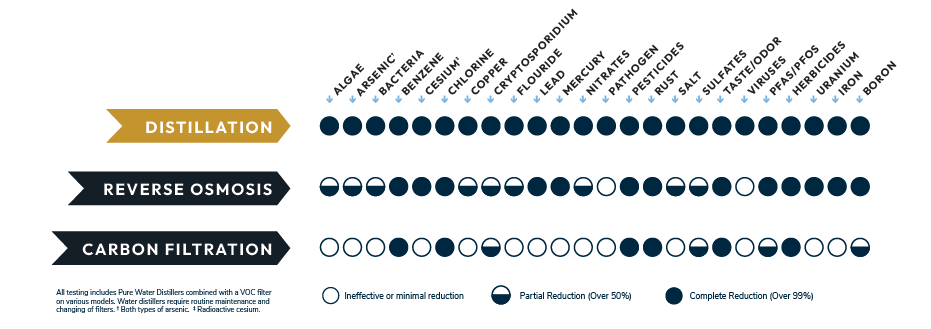
There are several treatment methods used to reduce arsenic in water, including:
Distillation
Adsorptive media filters
Ion exchange systems
Some Reverse Osmosis systems
Each method works differently and may vary in effectiveness depending on water composition, maintenance, and system design.
A Closer Look at Distillation
Distillation is a process that mimics the natural water cycle:
Water is heated until it turns into steam
Steam rises, leaving many contaminants behind
The steam cools and condenses back into liquid water
Because arsenic is a non-volatile contaminant, it does not evaporate with the steam and is left behind in the boiling chamber.
Pure Water systems also include a post-carbon filter to address any remaining volatile compounds.
Why Water Quality Awareness Matters
Understanding what’s in your water is the first step toward making informed decisions.
Arsenic is just one example of a contaminant that:
Cannot be detected without testing
Occurs naturally in many environments
Is regulated due to long-term exposure considerations
Being proactive about water quality, through testing, education, and appropriate treatment, helps ensure you know exactly what you’re consuming every day.
The Bottom Line
Arsenic in drinking water isn’t something you can see or taste, but it’s worth understanding.
Key takeaways:
Arsenic is a naturally occurring element that can enter groundwater
It is regulated by the EPA at 10 ppb in public water systems
Testing is the only way to know if it’s present in your water
Distillation removes 99.9% of Asenic in your drinking water
Considering Your Options
If you’re evaluating your home water quality, it’s helpful to look for solutions that are:
Consistent
Reliable
Designed to address a wide range of contaminants
At My Pure Water, our distillation systems are built to replicate one of nature’s most effective purification processes. By separating water from dissolved solids and many contaminants, distillation offers a straightforward approach to producing high-purity water at home.
If you’re curious about what’s in your water, testing is always a great first step, and from there, you can explore the options that best fit your household.





Leave a Reply