

Are There Drugs in My Water?
Pharmaceutical Residues in Drinking Water: How Do They Get There?
It’s a question more and more people are asking: Are there trace amounts of medications in my drinking water?
The short answer is that studies over the past few decades have detected very small amounts of pharmaceutical compounds in some water sources. These findings have sparked curiosity, concern, and a lot of misunderstanding. To make sense of it, it helps to step back and look at how water moves, how treatment works, and how trace substances can enter the water cycle in the first place.
This article takes a clear, education-first look at the topic, how pharmaceutical residues can enter water, what current systems are designed to do, and how purification methods like distillation fit into the conversation about water quality.
What Are “Pharmaceutical Residues”?
Pharmaceutical residues refer to trace amounts of medications or their byproducts that have been detected in water sources. These may include:
- Prescription medications
- Over-the-counter drugs
- Veterinary medicines used in agriculture
- Compounds are formed when medications break down in the body
It’s important to understand that when researchers talk about these residues, they typically refer to extremely low concentrations, often measured in parts per billion (ppb) or even parts per trillion (ppt). These levels are far below what would be considered a typical dose of any medication. The presence of these trace compounds is less about immediate effects and more about understanding how substances move through our environment and water systems.
How Do Pharmaceuticals Get Into Water?
To understand how trace residues can appear in drinking water, it helps to follow the path of water through everyday life.
-
Everyday Use and Disposal
When medications are taken, the body does not always fully absorb or break down every compound. Small amounts can pass through the body and enter wastewater systems through normal use. Additionally, improper disposal, such as flushing unused medications, can introduce compounds directly into wastewater.
-
Wastewater Treatment Systems
Municipal wastewater treatment facilities are designed to remove solids, reduce organic material, and disinfect water before it is released back into the environment. However, many treatment systems were not originally designed to specifically target trace pharmaceutical compounds, especially those present at extremely low concentrations. As a result, some compounds may pass through treatment processes and enter rivers, lakes, or groundwater.
-
Environmental Pathways
Once water is released back into the environment, it becomes part of a continuous cycle:
- Rivers and streams flow into reservoirs
- Groundwater can be influenced by surface activity
- Water is eventually withdrawn again for treatment and distribution
Along this journey, trace substances can become diluted, broken down, or persist depending on their chemical structure.
-
Drinking Water Treatment
Before reaching your tap, water is treated again, this time at a drinking water facility. These systems are designed to meet regulatory standards and typically include:
- Filtration
- Disinfection (such as chlorine or UV)
- Additional processes depending on the location
While these processes are effective for many contaminants, their removal efficiency can vary by compound.
Why This Topic Is Getting More Attention
Advances in testing technology have made it possible to detect substances at incredibly low levels. Decades ago, these trace compounds may not have been measurable at all.
Today, scientists can identify:
- Compounds at parts per billion
- Even parts per trillion (equivalent to a drop in a large swimming pool)
This doesn’t necessarily mean these substances are new; it means our ability to detect them has improved significantly. As a result, the conversation has shifted toward awareness, understanding, and water treatment approaches rather than assumptions.
Do These Compounds Change How Water Looks or Tastes?
One of the most important things to understand about trace contaminants—including pharmaceutical residues- is that they typically do not affect the taste, smell, or appearance of water.
Water can appear:
- Clear
- Odorless
- Neutral in taste
…while still containing dissolved substances at very low levels. This is why water quality is often described as something you can’t evaluate with your senses alone.
Why Removal Can Be Complex
Not all substances in water behave the same way. Pharmaceutical compounds can vary widely in their:
- Chemical structure
- Solubility
- Volatility (whether they evaporate with water)
Some compounds may break down relatively quickly in the environment, while others can persist longer. This variability is one reason why no single treatment method works the same way for every compound. Understanding this complexity is key to understanding why different purification approaches exist.
Where Distillation Fits Into the Picture
One method that approaches water purification from a different angle is distillation.
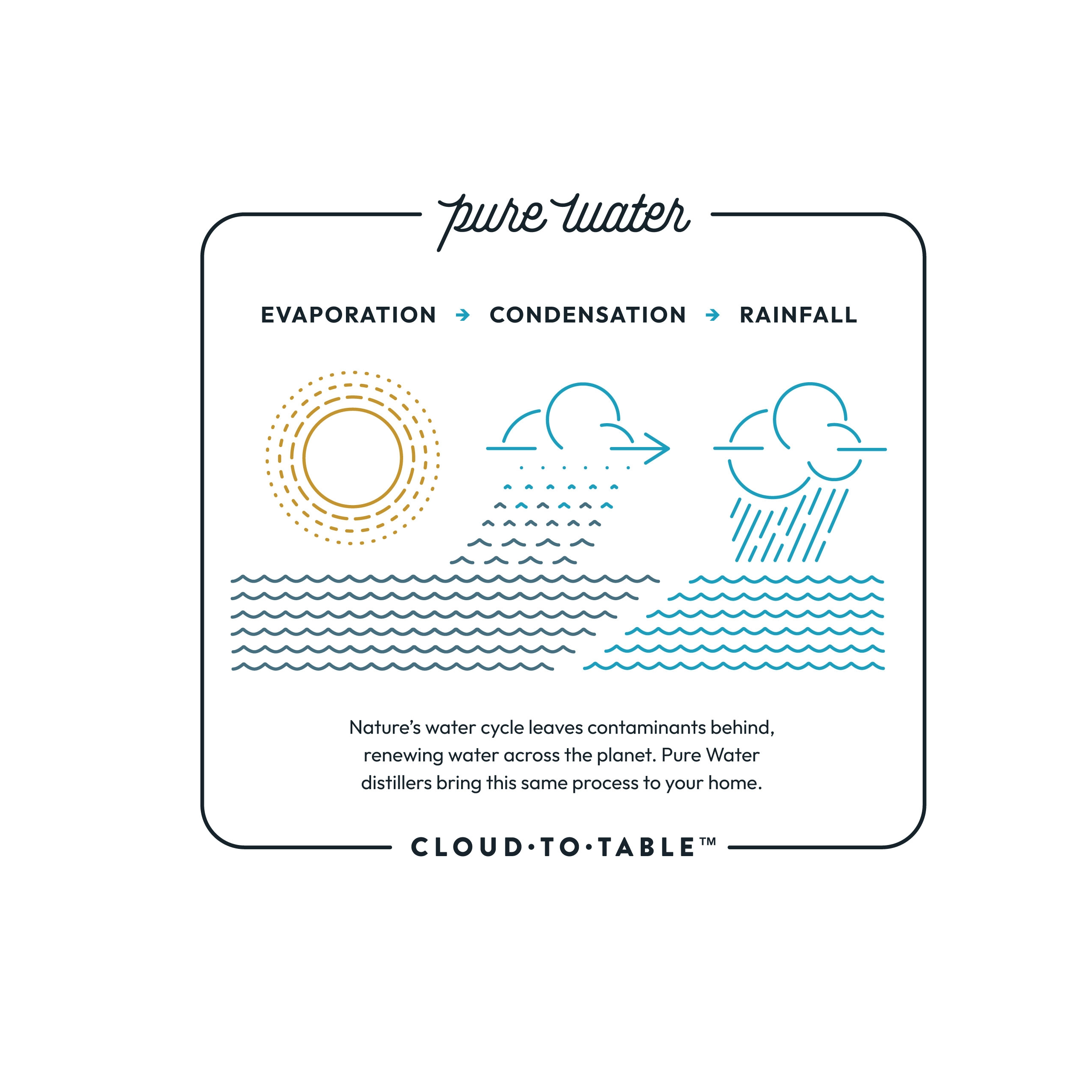
Distillation works by:
- Heating water until it becomes steam
- Leaving behind many dissolved solids and non-volatile substances
- Cooling the steam back into liquid form
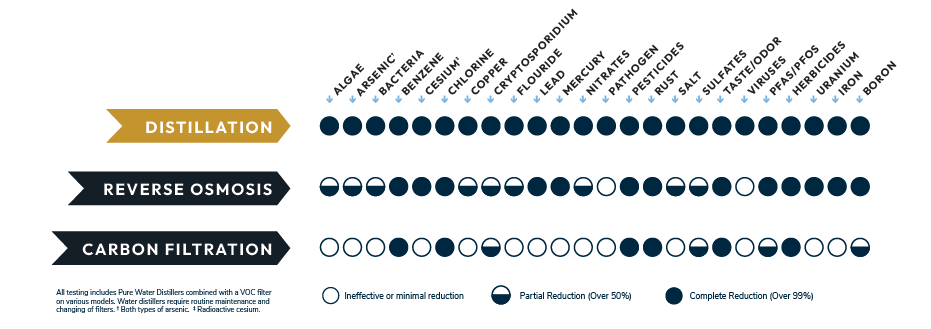
This process is often compared to the natural water cycle, where water evaporates, forms clouds, and returns as precipitation. Because distillation relies on phase changes (liquid to vapor and back), it separates water from many substances that do not evaporate with it.
A Note on Volatile Compounds
Some compounds are considered volatile, meaning they can evaporate with water. For this reason, many modern distillation systems incorporate carbon post-filtration to help capture compounds that may carry over with steam. This combination, distillation followed by carbon filtration, is designed to address a broader range of potential contaminants.
How My Pure Water Distillers Approach Purification
Water distillers from My Pure Water are built around this multi-step purification concept.
Their systems typically include:
- Boiling chambers made from stainless steel for durability and consistency
- Condensing coils that convert steam back into water
- Post-carbon filtration to help capture any remaining volatile compounds
This process focuses on separation rather than just filtration, meaning water is physically separated from many dissolved substances during purification. Rather than relying on a single barrier, distillation systems use a sequence of steps to produce purified water.
Why “Trace” Matters in the Conversation
When discussing pharmaceutical residues, or any contaminants, it’s important to keep scale in mind.
The term “trace” is used because these substances are:
- Present at extremely low concentrations
- Often measured in parts per billion or trillion
- Detected using highly sensitive instruments
This doesn’t diminish the importance of understanding water quality. Instead, it highlights how modern science allows us to observe what was previously undetectable. For many people, this awareness leads to a simple question: How can I better understand and manage what’s in my water?
Practical Steps for Understanding Your Water
If you’re interested in learning more about your own water quality, there are a few practical steps you can take:
-
Review Local Water Reports
Municipal water systems publish annual reports that outline tested contaminants and levels.
-
Consider Water Testing
Independent testing can provide additional insight, especially for well water or specific concerns.
-
Learn About Treatment Methods
Understanding how different purification systems work can help you make informed decisions based on your priorities.
A Broader Perspective on Water Quality
The presence of trace pharmaceutical residues is part of a much larger conversation about how modern life interacts with natural systems. From agriculture to industry to everyday household use, many substances can enter the environment. Water, as a universal solvent, naturally carries what it encounters along the way. At the same time, advancements in science, engineering, and water treatment continue to evolve—providing more options than ever before for understanding and managing water quality.
Bringing It All Together
So, are there drugs in your water?
Research has shown that trace amounts of pharmaceutical compounds have been detected in some water sources, primarily due to the movement of water through the environment and the design of treatment systems. These findings don’t change the fundamental role of water, but they do highlight an important point:
What you see, taste, or smell isn’t always the full picture.
Understanding how contaminants enter water, and how different purification methods address them, can help you make more informed decisions about your home water. For those exploring purification options, systems from My Pure Water offer a separation-based, phase-change, multi-step approach that aligns with the goal of producing high-purity water.
Final Thought
Water is constantly moving, changing, and interacting with the world around it. As our ability to measure and understand it improves, so does our ability to make intentional choices about the water we use every day.

Leave a Reply