


Do Water Filters Remove PFAS?
Understanding Your Options for Reducing “Forever Chemicals”
If you’ve been following recent water quality news, you’ve likely heard the term PFAS. These man-made chemicals have become one of the most discussed drinking water concerns in recent years, prompting many homeowners to ask an important question: Do water filters remove PFAS?
The answer is not always straightforward. While some water treatment technologies can significantly reduce PFAS levels, not all filters are designed to address these contaminants. Understanding how PFAS behave in water and which treatment methods are effective can help you make informed decisions about the water you drink every day.
In this article, we’ll explore what PFAS are, why they’re receiving so much attention, which water treatment technologies may reduce them, and how distillation fits into the conversation.

What Are PFAS?
PFAS stands for per- and polyfluoroalkyl substances, a large group of synthetic chemicals used in manufacturing and consumer products since the 1940s.
These chemicals are valued for their resistance to heat, water, grease, and stains. Over the decades, PFAS have been used in products such as:
- Non-stick cookware
- Water-resistant clothing
- Food packaging
- Stain-resistant carpets and furniture
- Firefighting foams
- Industrial manufacturing processes
The challenge is that PFAS do not easily break down in the environment. Because they can persist for long periods, they have earned the nickname “forever chemicals.”
How Do PFAS Get Into Drinking Water?
PFAS can enter water sources through a variety of pathways.
Potential sources include:
- Industrial discharges
- Landfills
- Wastewater treatment plants
- Firefighting foam training sites
- Manufacturing facilities
- Agricultural applications involving biosolids
Once released into the environment, PFAS may migrate into groundwater, rivers, lakes, and reservoirs that serve as drinking water sources. According to the U.S. Environmental Protection Agency (EPA), PFAS have been detected in water systems across the United States, prompting increased monitoring and regulatory efforts.
Why Are People Concerned About PFAS?
One reason PFAS receive so much attention is their persistence. Unlike many contaminants that naturally degrade over time, PFAS can remain in the environment for years. Because of this, water utilities, researchers, regulators, and consumers have devoted significant resources to understanding their presence in drinking water.
In 2024, the EPA finalized national drinking water standards for several PFAS compounds, reflecting growing efforts to address these contaminants at both the municipal and household levels. As awareness increases, many homeowners are exploring treatment options that may help reduce PFAS in their water.
Do Standard Water Filters Remove PFAS?
Not necessarily. The term “water filter” can describe many different technologies, and not all are designed to address PFAS.
For example:
Basic Pitcher Filters
Some pitcher-style filters may reduce certain contaminants that affect taste and odor, but performance varies significantly by manufacturer and model.
Unless a product has been specifically tested and certified for PFAS reduction, consumers should not assume it will effectively remove these compounds.
Faucet-Mounted Filters
Certain faucet filters use activated carbon and may provide some PFAS reduction, depending on their design and certification.
However, effectiveness can vary based on:
- Contact time
- Filter media quality
- Filter maintenance
- Specific PFAS compounds present
Refrigerator Filters
Many refrigerator filters focus primarily on improving taste and reducing chlorine. Some models may reduce certain contaminants, but not all are evaluated for PFAS removal.
Checking manufacturer specifications and certifications is essential.
Which Water Treatment Technologies Can Reduce PFAS?
Research and testing have identified several treatment methods that can help reduce PFAS concentrations in drinking water.
Activated Carbon
Activated carbon is one of the most commonly used treatment technologies for PFAS reduction. Granular activated carbon (GAC) works by adsorbing contaminants onto a highly porous surface. Many whole-house and point-of-use filtration systems use activated carbon to reduce various contaminants, including some PFAS compounds.
Performance depends on factors such as:
- Carbon quality
- System design
- Water chemistry
- Maintenance schedule
- Specific PFAS compounds present
Reverse Osmosis
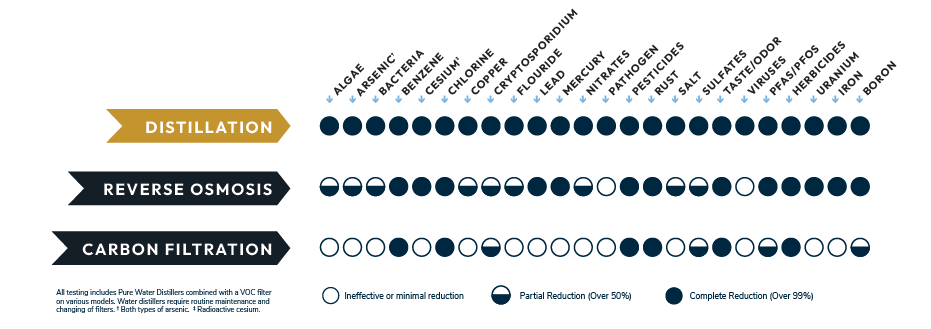
Reverse osmosis (RO) systems use a semi-permeable membrane to separate many dissolved contaminants from water. Numerous studies have found that properly functioning RO systems can achieve substantial reductions in many PFAS compounds. Because reverse osmosis physically separates contaminants from water molecules, it is often considered one of the more effective residential treatment options for PFAS reduction.
“Properly functioning” RO systems mean that regular maintenance is required to keep them functioning as they should.
Distillation
Distillation is another treatment technology frequently discussed in conversations about PFAS.
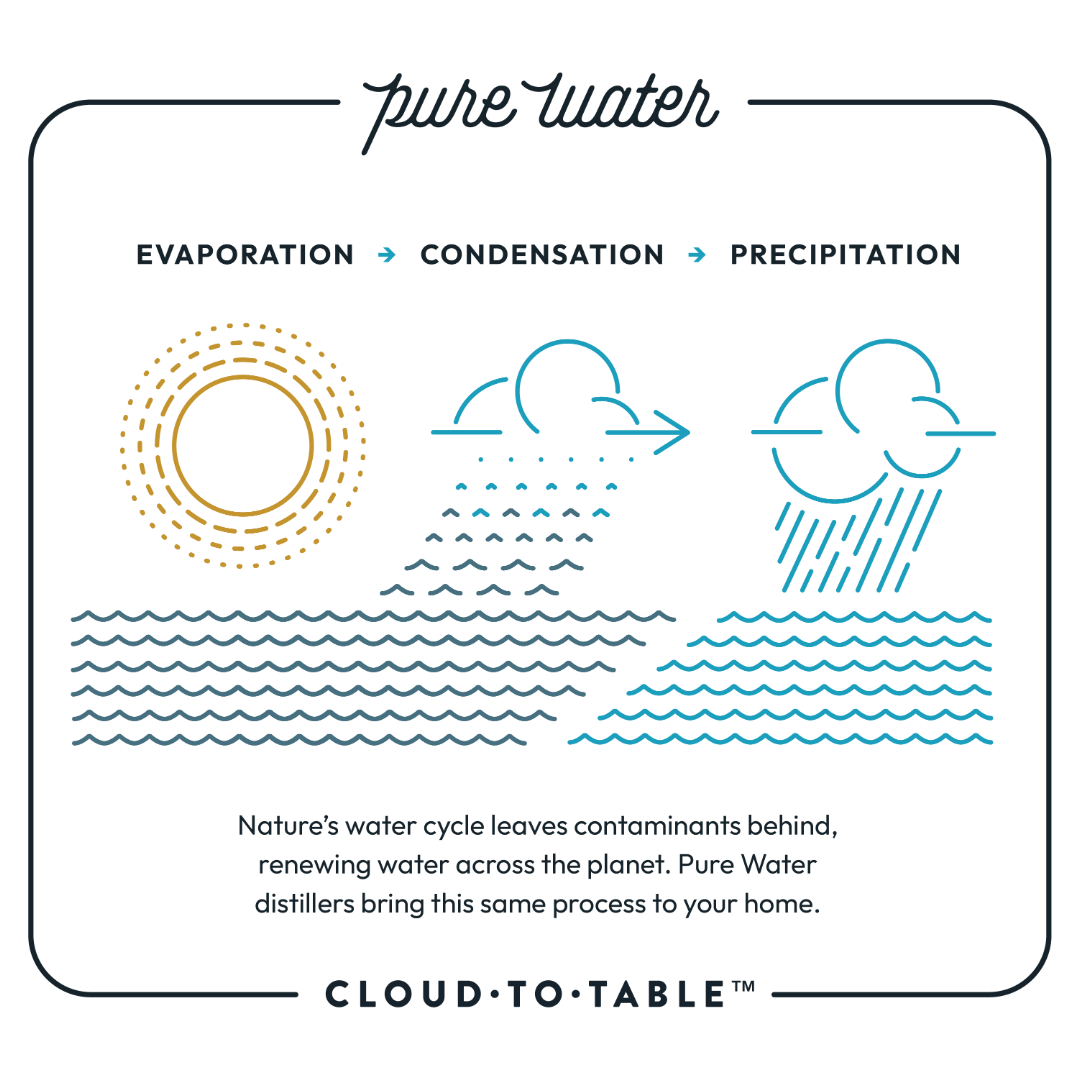
The distillation process mimics nature’s hydrologic cycle. Water is heated until it becomes steam, leaving many contaminants behind. The steam is then condensed back into liquid water. Because many contaminants, including dissolved solids, metals, minerals, and numerous chemical compounds, do not vaporize with the water, they remain in the boiling chamber rather than entering the final distilled water. Many water distillation systems also incorporate post-treatment carbon filtration to remove volatile organic compounds with lower boiling points.
As with any treatment technology, performance can vary based on system design, maintenance, and the specific contaminants present.
Pure Water Distillers have been third-party tested and shown to remove over 99.9% of PFAS from drinking water.
Why Certification Matters
When evaluating water treatment systems for PFAS reduction, certification is often one of the most important considerations.
Independent organizations such as the NSF International and the Water Quality Association evaluate water treatment products against established performance standards.
Rather than relying solely on marketing claims, consumers should look for:
- Independent testing data
- Third-party certifications
- Manufacturer performance documentation
- Proper installation and maintenance requirements
These factors help provide confidence that a system performs as intended.
Is Municipal Water Safe?
Municipal water systems in the United States are regulated and routinely monitored under federal and state drinking water standards. Water utilities continuously test for a range of contaminants and are increasingly monitoring PFAS as new regulations take effect. It is important to note that “safe” does not mean “absent”. So, while municipal water is deemed safe, it does not mean PFAS are absent.
Consumers can learn more about their local water quality by reviewing their annual Consumer Confidence Report (CCR), typically available from their water provider.
These reports provide valuable information about:
- Water sources
- Detected contaminants
- Regulatory compliance
- Treatment methods
Understanding your local water quality can help guide decisions about additional treatment options.
Choosing the Right Water Treatment System
When evaluating options, consider:
Your Water Source
Private wells and municipal water systems may face different water quality challenges.
Your Water Quality Data
A recent water analysis can identify specific contaminants present in your water.
Maintenance Requirements
Every treatment system requires ongoing maintenance to perform effectively.
Long-Term Costs
Consider replacement filters, energy usage, service requirements, and system lifespan when comparing technologies.
Desired Water Quality Goals
Some homeowners focus on improving taste. Others are interested in reducing specific contaminants or producing highly purified water.
Understanding your priorities can help narrow the available options.
Distillation and Water Purity
For homeowners seeking a treatment method that removes a broad range of contaminants, distillation remains the most established purification technology available.
Unlike technologies that target only certain categories of contaminants, distillation works through a physical phase-change process that separates water from many dissolved substances. This is one reason distilled water has long been used in laboratories, medical facilities, manufacturing environments, and homes where high-purity water is desired.
At My Pure Water, we’ve spent decades helping customers understand water quality and the science behind purification. Our systems use the same fundamental process found in nature’s hydrologic cycle, evaporation, condensation, and precipitation, to produce high-purity distilled water right at home.
Final Thoughts
So, do water filters remove PFAS?
Some do, and some do not.
The effectiveness of any treatment system depends on the technology being used, the specific PFAS compounds present, system maintenance, and independent performance testing. Activated carbon, reverse osmosis, and distillation are among the treatment methods commonly used to reduce a variety of contaminants found in drinking water.
As public awareness of PFAS continues to grow, understanding your local water quality and evaluating treatment options carefully can help you make informed decisions about your drinking water.
The more you understand what’s in your water—and how different treatment technologies work—the better equipped you’ll be to choose a solution that aligns with your household’s needs and water quality goals.

Sources
- U.S. Environmental Protection Agency (EPA) – PFAS Explained
- EPA National Primary Drinking Water Regulation for PFAS
- Centers for Disease Control and Prevention (CDC) – PFAS Information
- Water Quality Association (WQA)
- NSF International Drinking Water Treatment Standards
- U.S. Geological Survey (USGS) PFAS Resources
Leave a Reply